Testing status: PG Systems Lab created a free systeme.io account and tested a live opt-in path through contact capture, automatic tagging, and authenticated workflow email sending. Custom-domain authentication was completed, and an automated workflow email reached Gmail. SPF, DKIM, and DMARC passed; Gmail placed the message in Promotions rather than Primary. Yahoo email placement and large-scale deliverability remain untested.
Affiliate disclosure: PG Systems Lab may earn a commission if you sign up through links in this article. This does not affect the testing process or editorial verdict. Read our Affiliate Disclosure.
- Quick Answer: Is systeme.io Free, a Trial, and Right for You?
- Who Should Start Free—and Who Should Skip It
- What PG Systems Lab Tested on the Free Plan
- Ease of Use
- Key Advantages
- Key Limitations
- What the Free Plan Includes—and the Limits That Matter
- Who Should Avoid systeme.io
- When to Upgrade
- Testing Notes
- Final Verdict
- systeme.io Plan Fit Calculator
- FAQ
- Is systeme.io free forever, or is it a free trial?
- Do I need a credit card for the Free plan?
- Can I build funnels, send emails, and use a custom domain on the Free plan?
- What did PG Systems Lab actually test in systeme.io?
- Did you test systeme.io email deliverability?
- What are the main free-plan automation limits?
- Is systeme.io a full CRM replacement?
- Who should consider the systeme.io free plan?
- Official Sources
Quick Answer: Is systeme.io Free, a Trial, and Right for You?
Yes. systeme.io currently offers a permanent $0 Free plan, not a time-limited trial, and its official pricing says no credit card is required. The current Free plan lists up to 2,000 contacts, 3 sales funnels, 1 custom domain, and unlimited email sends. PG Systems Lab tested a real Free-account path: a published opt-in funnel, CRM contact creation, workflow-triggered tag assignment, custom-domain authentication, and one authenticated workflow email delivered to Gmail.
The main practical limitation is capacity, not sign-up: the current Free plan lists 1 tag, 1 automation rule, 1 workflow, and 1 email campaign. That can support one focused lead path, but it becomes restrictive when you need separate segments or parallel customer journeys.
Who Should Start Free—and Who Should Skip It
Best fit
- Solo operators validating one offer: The free account can support an initial opt-in path without requiring a paid subscription before the workflow is understood.
- Creators and consultants building a simple lead funnel: A landing page, CRM record, and basic tag action can live in the same system.
- Budget-conscious small businesses: The tested path may replace a separate page builder, lightweight contact database, and basic connector during early validation.
- Small agencies running a controlled internal evaluation: The free tier is useful for checking how the platform behaves before deciding whether its structure fits a client process.
Who should skip it
- Businesses that need proven Yahoo placement, sustained sending, or high-volume inbox placement before adoption.
- Teams that require multiple segments, lifecycle tags, or parallel automations on the free plan.
- Organizations already using advanced CRM pipelines, scoring, branching, permissions, or reporting.
- Agencies that need confirmed client governance, approval controls, white-labeling, or tested high-volume operation.
- Senders for whom inbox placement is decision-critical and who cannot run an authenticated-domain test before migration.
What PG Systems Lab Tested on the Free Plan
PG Systems Lab tested the following controlled path on a Free account. The official plan allowances above are product information; the results below are our observed test results.
PG Systems Lab created a free account and a test funnel named PGSL Systeme.io Test. We then created and published an Opt-in page and submitted an operator-controlled Yahoo address through its form.
The submitted address appeared in systeme.io’s CRM. We created and activated a workflow with these settings:
- Trigger: Funnel form subscribed
- Funnel: PGSL Systeme.io Test
- Step: Opt-in page
- Action: Add a tag
- Tag: PGSL-Test-Subscribed
After another controlled submission, the contact received the expected tag. The tested path was:
Form submission → CRM contact creation → workflow trigger → automatic tag assignment
We did not use customer data, test a paid plan, run a large list, build a complex workflow, or measure sales and conversion outcomes.
Funnel and contact capture
The funnel builder passed the limited functional test we set for it: create an opt-in page, publish it, and accept a real controlled submission. The page was not merely saved as a draft. It was live and connected to the contact-capture path used in this review.
For a solo operator, that reduces early integration work. A separate landing-page service, form connector, and contact database may not be necessary for the first validation funnel. The potential return is operational rather than a fabricated revenue number: fewer systems to configure, fewer handoffs to troubleshoot, and no subscription cost while testing the basic path.
The test does not establish conversion quality, page speed under traffic, template flexibility, analytics accuracy, payment behavior, or how the builder performs across a large campaign library. Those questions require separate evidence.
CRM contact capture
The submitted Yahoo test address was automatically added to systeme.io’s CRM. We did not have to export the form response or use a third-party connector to create the record.
This is enough to confirm basic contact capture in our setup. It is not enough to describe systeme.io as a full replacement for a mature sales CRM. We did not test deal management, scoring, deduplication at scale, field governance, imports, exports, permissions, or integrations with an existing sales process.
For a small business, the distinction matters. If the immediate job is simply to retain an opt-in and trigger a basic next step, the built-in CRM may reduce tool sprawl. If sales representatives need structured opportunities, forecasting, and complex ownership rules, a dedicated CRM evaluation is still necessary.
Workflow and tag assignment
We configured the workflow to listen for a subscription on one named funnel step and then add one named tag. After the workflow was activated, a form submission triggered the action and the PGSL-Test-Subscribed tag appeared on the contact.
This confirms that systeme.io automation was functional for the exact trigger-and-action sequence tested. It does not confirm branching, delays, error recovery, multi-step nurture logic, webhook reliability, or performance at volume.
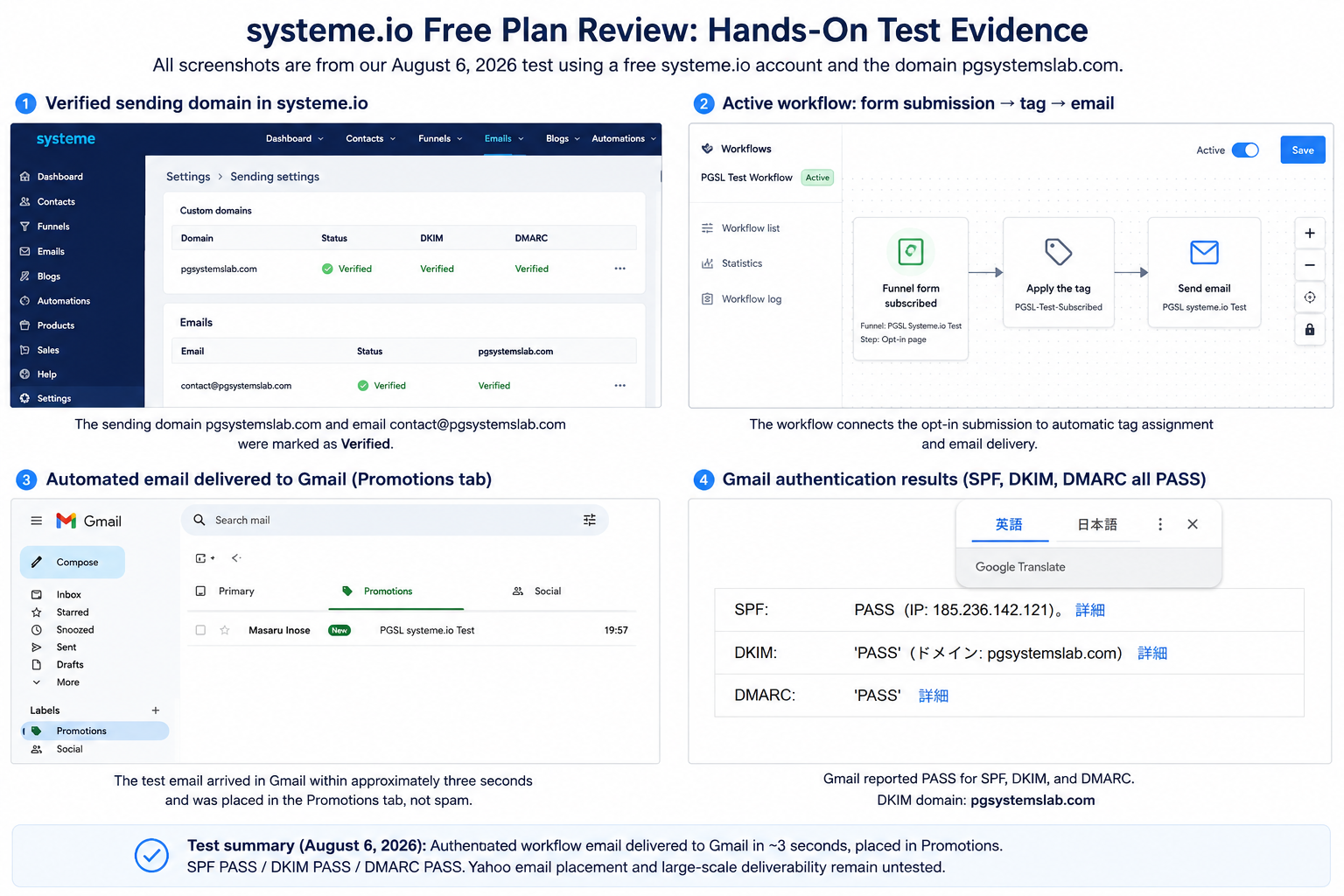
We then added an email-send action to the existing PGSL Test Workflow. Its completed path was Funnel form subscribed → Apply the PGSL-Test-Subscribed tag → Send “PGSL systeme.io Test”. A new Gmail address, not previously registered in systeme.io, submitted the published Opt-in page; the workflow fired and sent the automated test email.
The free-plan ceiling is important here. The official pricing table listed one automation rule, one workflow, and one tag on August 5, 2026. That is enough to prove a concept, but it leaves little room for separate lead sources, lifecycle stages, customer tags, or multiple client processes.
Custom-domain authentication and Gmail delivery
The sender address contact@pgsystemslab.com was verified in the account, but the custom domain pgsystemslab.com still showed Pending. When we tried to use the address as the sender, systeme.io displayed a warning that domain authentication was required, and the sender setting could not be saved.
This behavior is consistent with systeme.io’s current help documentation, which says custom-domain authentication is mandatory for sending email through the platform and that the sender address associated with the authenticated domain must also be confirmed.
Custom-domain authentication was still pending during the initial test. In our observed sequence, after the required vendor-provided DNS records were added, the domain status changed to Verified within approximately one hour. This sequence does not isolate one DNS record as the cause of verification.
After the domain became Verified, we saved Masaru Inose <contact@pgsystemslab.com> as the sender and tested the workflow email. The received Gmail message showed SPF: PASS, DKIM: PASS for pgsystemslab.com, and DMARC: PASS. It arrived in approximately three seconds and was classified in Promotions rather than spam.
The earlier pending state is not evidence that delivery would fail, nor is this one Gmail result evidence of overall deliverability. The Yahoo address in this review was used for form submission, CRM contact creation, workflow triggering, and tag assignment; Yahoo delivery and inbox placement remain untested.
Ease of Use
The core path was understandable once the funnel, step, trigger, action, and tag relationships were clear. Keeping these components in one account reduced connector setup. The interface still requires the operator to understand where each object lives and how they relate.
A beginner may need time to distinguish an automation rule from a workflow, select the correct funnel step, create the tag before assigning it, and understand why a verified email address is not the same as an authenticated sending domain. We therefore describe the tested path as functional, not automatically easy for every new user.
If this is your first automation project, our Email Automation for Small Teams guide explains how to start with one trigger, one action, and a clear stop condition.
Key Advantages
- One-account validation: The page, form, CRM record, workflow, and tag were connected without a separate automation service.
- Low-cost proof of concept: The free tier allowed us to test the full capture-to-tag path before paying.
- Published-path evidence: We tested a live opt-in submission, not only a builder preview.
- Clear basic trigger scope: The workflow could target a named funnel and a named step.
- Authenticated Gmail delivery: The workflow email successfully reached Gmail from the verified sending domain.
- Received-message authentication: SPF, DKIM, and DMARC all passed in the received Gmail message.
- Room to test other core tools: The current free plan also lists funnels, email campaigns, a custom domain, and other limited features, although this review does not claim they were all tested.
Key Limitations
- Very limited automation capacity: One tag, one automation rule, and one workflow can become restrictive as soon as the business needs another segment or process.
- Promotions placement: Gmail classified the controlled test message under Promotions rather than Primary.
- Limited delivery sample: Only one controlled Gmail delivery was tested.
- Broader delivery not tested: Yahoo delivery, sustained sending, reputation over time, list quality, and large-scale inbox placement were not tested.
- Basic CRM evidence only: Contact creation worked, but we did not test advanced sales operations.
- Navigation has a learning curve: Beginners must understand several related objects and settings.
- No outcome evidence: The test did not measure leads, revenue, conversion lift, or time savings at scale.
What the Free Plan Includes—and the Limits That Matter
Funnels, email, and custom domains
The following limits come from systeme.io’s official pricing table, checked on August 5, 2026. They are current product information, not hands-on findings, and can change.
| Free-plan item | Official limit checked | Decision impact |
|---|---|---|
| Price | $0; no credit card required; no stated expiry | Supports evaluation without an initial subscription. |
| Contacts | 2,000 | Usable for an early list, but growth beyond the limit requires a plan decision. |
| Sales funnels | 3 | Enough for a small proof of concept, not a broad campaign portfolio. |
| Funnel steps | 15 | Allows several pages across the three funnels, subject to the total cap. |
| Tags | 1 | A major constraint for segmentation and lifecycle management. |
| Automation rules | 1 | Suitable for one simple rule, not multiple independent processes. |
| Workflows | 1 | Enough for this test; restrictive for parallel journeys. |
| Email campaigns | 1 | Limits separate nurture sequences. |
| Emails sent | Unlimited | This is an official allowance, not proof of deliverability or unlimited practical volume. |
| Custom domains | 1 | Can support one branded setup after successful configuration. |
| A/B tests | 1 | Allows a limited experiment; not tested in this review. |
Always confirm the current table before signup or publication. A nominally unlimited send allowance does not remove list-quality, sender-reputation, consent, authentication, or deliverability responsibilities.
Who Should Avoid systeme.io
Avoid adopting systeme.io on the strength of this single test alone if email delivery is your most important requirement. Run controlled tests with your own domain, audience, and target mailbox providers before migrating an established list.
The platform may also be too limited for a company with established CRM governance, many active segments, complex branching, strict approval processes, or numerous concurrent campaigns. A small agency should separately verify client ownership, account separation, access control, reporting, export, and offboarding before placing client work in the system.
For a broader agency selection framework, see Best Email Marketing Software for Small Agencies. If dedicated email tools are also on your shortlist, our GetResponse vs Mailchimp comparison shows how to compare workflow fit without relying only on feature counts.
When to Upgrade
On August 5, 2026, systeme.io’s official pricing page listed four plans: Free at $0, Startup at $17 per month, Webinar at $47 per month, and Unlimited at $97 per month. The page also offered annual billing. Prices, currency, billing intervals, promotions, taxes, and plan contents can change, so verify the final checkout terms.
See the stay-free versus upgrade framework.
The practical upgrade trigger is not simply that a paid plan has more features. Upgrade when a tested business process requires more capacity than the free plan provides. The first likely constraints are the single tag, automation rule, and workflow. A second audience state or separate lead source can already create that need.
For ROI, compare the paid tier with the cost and operating effort of the specific tools it would replace. Include migration time, staff learning, governance, and the risk of concentrating several functions in one platform. Do not count hypothetical revenue as a return before a live process produces evidence.
Testing Notes
| Item | Status | Evidence boundary |
|---|---|---|
| Free account creation | Tested | Account created successfully. |
| PGSL Systeme.io Test funnel | Tested | Created in the free account. |
| Opt-in page creation and publication | Tested | Published page accepted a controlled submission. |
| CRM contact creation | Tested | Submitted Yahoo test address appeared as a contact. |
| Workflow trigger | Tested | Funnel form subscription trigger ran for the selected funnel and step. |
| Automatic tag assignment | Tested | PGSL-Test-Subscribed was applied to the contact. |
| Sender address verification | Observed | contact@pgsystemslab.com showed Verified. |
| Custom-domain authentication | Tested / Verified | pgsystemslab.com changed to Verified after the DMARC reporting address was added in this test. |
| Automated email send | Tested | PGSL Test Workflow sent the controlled Gmail message from Masaru Inose <contact@pgsystemslab.com>. |
| Gmail delivery | Tested | Delivered in approximately three seconds. |
| Gmail placement | Tested | Promotions tab, not spam. |
| SPF | PASS | Confirmed in the Gmail original message. |
| DKIM | PASS | Confirmed in the Gmail original message; domain: pgsystemslab.com. |
| DMARC | PASS | Confirmed in the Gmail original message. |
| Yahoo delivery and inbox placement | Not tested | The Yahoo address was used for form, CRM, workflow-trigger, and tag-assignment testing, not email delivery. |
| Paid plans, complex automation, scale, and conversion impact | Not tested | Outside this review’s scope. |
Final Verdict
Within the tested scope, the systeme.io free plan worked as a basic all-in-one funnel, CRM, and automation environment. A published form created the contact, triggered the selected workflow, and assigned the expected tag. That makes the platform promising for a solo operator or small business that wants to validate one simple lead-capture process while keeping initial software cost low.
The free plan is not a finished operating system for every small business. Its single tag, automation rule, and workflow create an early capacity ceiling. In the completed email test, custom-domain authentication succeeded, the automated Gmail delivery succeeded, and SPF, DKIM, and DMARC passed. Gmail classified the message as Promotions.
Our functional verdict is therefore positive but bounded: systeme.io was functional in the published funnel, CRM contact creation, workflow trigger, automatic tag assignment, automated Gmail delivery, and authentication path tested. This is stronger evidence than a builder-only review, but one controlled email does not establish long-term or high-volume deliverability, Yahoo placement, or sender reputation.
systeme.io Plan Fit Calculator
Find the lowest plan that fits your contacts, sales funnels, and courses. All listed plans include unlimited email sends.
Upgrade from the previous tier: Why: Your result
Check current plan details before signing up.
Try systeme.io’s Free plan if the tested workflow matches your current needs.
FAQ
Is systeme.io free forever, or is it a free trial?
Systeme.io’s official pricing currently lists the Free plan at $0 and says it never expires. It is a permanent Free plan rather than a time-limited trial. Check the current official terms before signup because plan details can change.
Do I need a credit card for the Free plan?
No. Systeme.io’s current official pricing says no credit card is required to start the Free plan.
Can I build funnels, send emails, and use a custom domain on the Free plan?
According to systeme.io’s current official pricing, the Free plan includes up to 3 sales funnels, unlimited email sends, and 1 custom domain. PG Systems Lab tested one published opt-in funnel, authenticated-domain setup, and one workflow email to Gmail; we did not test large-scale sending or broad inbox placement.
What did PG Systems Lab actually test in systeme.io?
We created a free account, built and published an opt-in page, confirmed CRM contact creation and automatic tagging, and sent an authenticated workflow email to Gmail. The Gmail message arrived in approximately three seconds, was placed in Promotions, and passed SPF, DKIM, and DMARC checks.
Did you test systeme.io email deliverability?
Yes, within a limited controlled test. An automated workflow email reached Gmail in approximately three seconds, SPF, DKIM, and DMARC passed, and Gmail placed it in Promotions rather than spam. This does not establish Yahoo placement, high-volume performance, or long-term sender reputation.
What are the main free-plan automation limits?
The official table listed one tag, one automation rule, and one workflow on the Free plan as of August 5, 2026. Those limits support a basic proof of concept but can restrict segmentation and parallel customer journeys.
Is systeme.io a full CRM replacement?
Our test confirmed automatic contact creation and tagging only. It did not evaluate advanced pipeline management, forecasting, permissions, large imports, or complex sales operations, so it cannot support a general CRM-replacement claim.
Who should consider the systeme.io free plan?
It is worth testing for solo operators, creators, consultants, and small businesses that need one simple funnel-to-contact workflow and want to limit initial software cost. Teams with complex automation or decision-critical deliverability needs should conduct additional testing.
Official Sources
Official product information was checked on August 5, 2026. Interfaces, limits, and prices can change.